
Crash games have become central to the world of online instant gaming. Their appeal lies in simple mechanics, constant tension, and decisions made in fractions of a second. Sugar Daddy fits squarely into this category while standing out thanks to a deliberately provocative and visually distinctive theme.
Unlike most crash games, which rely on rockets, planes, or abstract graphics, Sugar Daddy uses a human-centered visual narrative. This artistic choice doesn’t change the game mechanics but strongly influences the emotional experience for the player. This article provides a thorough, responsible analysis of the game, highlighting its mechanics, risks, and best practices.
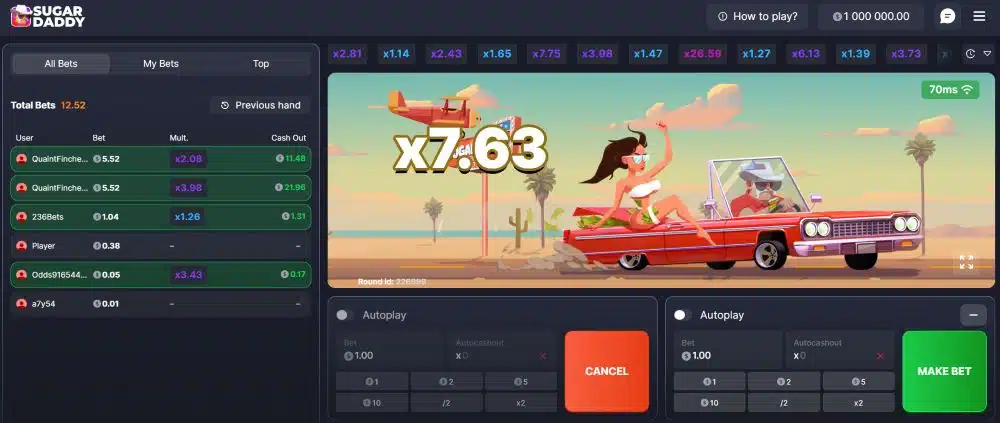
Sugar Daddy is a crash game developed by InOut Games. Players drive a 1960s convertible through the desert, taking their dream partner along, while a multiplier climbs up to x1000. The game combines retro graphics, exciting crash mechanics, and high potential winnings.
Key Features
| Feature | Details |
|---|---|
| Provider | InOut Games |
| RTP (Return to Player) | 95% |
| Maximum Multiplier | x1000 |
| Maximum Win | €2,000,000 |
| Minimum Bet | €0.05 |
| Maximum Bet | €2,000 |
| Release Date | November 28, 2024 |
| Platforms | Mobile, Desktop |
| Game Mode | Real Money |
| Technology | Provably Fair, HTML5 |
| Max Simultaneous Bets | 2 |
| Style | 1960s, Retro |
Highlights
- Simple and intuitive crash game accessible to beginners.
- Progressive multiplier up to x1000, with winnings up to €2,000,000.
- Mobile-compatible with no download required, using HTML5 and Provably Fair technology.
Overview of Sugar Daddy
Sugar Daddy is a multiplayer crash game. All players participate in the same rounds simultaneously, watching a shared multiplier increase. The round continues until the sequence abruptly ends.
The concept is simple:
- Cash out before the sequence ends to secure your winnings.
- Wait too long, and you lose your stake.
Despite its apparent simplicity, the game generates high psychological pressure, amplified by speed and the illusion of control.
A Visually Distinct Theme
The game’s originality comes from its visual presentation. Sugar Daddy places players in a luxurious world, featuring couples, wealth symbols, travel, and indulgence. While this theme doesn’t affect odds, it enhances immersion compared to traditional crash games.
Key effects of this aesthetic choice:
- Makes the game more memorable and visually distinct.
- Can distract players from critical cashout moments.
This is particularly relevant for players sensitive to visual stimuli.
Gameplay Mechanics
Round Structure
Each round follows a consistent sequence:
- Place one or two bets before the round starts.
- The multiplier begins to rise.
- Decide when to cash out.
- If the sequence ends before cashing out, the bet is lost.
Round duration is unpredictable—some end almost immediately, while others allow the multiplier to climb. This variability drives adrenaline but makes accurate prediction impossible.
The Role of Cashout
The cashout is the only strategic decision in Sugar Daddy:
- Manual: triggered by the player in real time.
- Automatic: preset before the round begins.
Automatic cashout is particularly important due to the game’s speed. Even milliseconds of delay can turn a potential win into a loss.
Placing Two Simultaneous Bets
Sugar Daddy allows placing two independent bets per round, creating strategic flexibility:
- A conservative bet for quick cashout.
- A riskier bet aiming for a higher multiplier.
While this may provide an illusion of safety, it does not reduce overall risk—it simply spreads exposure differently.
Round History and Cognitive Bias

The game displays a limited history of previous rounds. Players may mistakenly assume patterns exist:
- A winning streak does not guarantee future success.
- A losing streak does not predict an imminent turnaround.
Building a strategy solely on past rounds exposes players to emotion-driven decisions, often counterproductive. Each round is independent.
Potential Winnings vs. Statistical Reality
Multipliers can theoretically reach very high levels, but such scenarios are rare. Most rounds end at moderate levels. Key points to understand:
- Extreme multipliers exist but are not representative.
- High wins occur infrequently.
- Consistency comes from timely cashouts.
Chasing “jackpot” outcomes usually leads to repeated losses.
Settings and Customization
Options are intentionally limited to maintain game speed. Players can adjust:
- Sound settings
- Animations
- Certain visual elements
Reducing distractions can improve focus, especially during longer sessions.
Transparency and Fairness
Sugar Daddy operates on a verifiable generation system. Each round is determined by cryptographic elements that allow post-game fairness checks.
Fairness guarantees no manipulation but does not reduce volatility. Being fair does not mean predictable or profitable.
Autoplay and Automation
The game includes an autoplay feature to run rounds automatically based on predefined settings. This can help structure sessions but carries a risk of inattention.
Automation does not make strategic cashout decisions. Without proper automatic cashout settings, it can amplify losses.
Responsible Gaming Best Practices
Recommended Approach
- Use demo mode before wagering real money.
- Set a clear objective for each session.
- Prefer quick cashouts.
- Employ automatic cashout if latency is noticeable.
Common Mistakes to Avoid
- Increasing bets after a loss.
- Extending sessions to “recover” losses.
- Relying on visible history as a predictive tool.
- Being distracted by the game’s aesthetic.
Importance of Demo Mode
Demo mode allows players to:
- Understand the real pace of rounds.
- Observe early terminations.
- Recognize the emotional impact of the game.
It is essential to appreciate that Sugar Daddy is a game of timing, not prediction.
Advantages and Limitations
Pros:
- Simple and accessible mechanics
- Fast-paced, dynamic gameplay
- Unique theme in the crash game genre
- Ability to structure risk
Cons:
- High emotional pressure
- Large wins are very rare
- Dependent on timing and latency
- Limited history for reliable analysis
FAQ
Is Sugar Daddy different from other crash games?
Mechanics are similar, but the visual theme and betting options set it apart.
Can you win consistently?
The game is chance-based. Regularity depends solely on player discipline.
Is automatic cashout recommended?
Yes, especially if latency affects manual timing.
Is it suitable for beginners?
Yes, provided players start in demo mode and set strict limits.
Does the theme affect outcomes?
No, it only impacts the emotional experience.
Conclusion
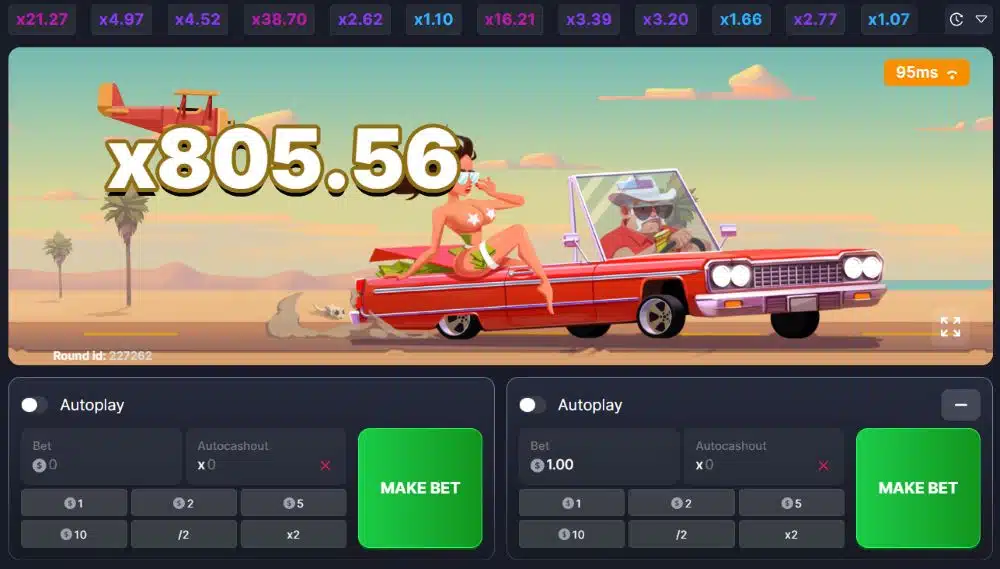
Sugar Daddy is a classic crash game in mechanics, yet original in presentation. Its theme captures attention and enhances immersion without altering core rules. Like all games of this type, discipline outweighs excessive risk-taking.
Approached with clear limits, awareness, and an understanding of timing, Sugar Daddy delivers fast-paced, entertaining sessions, but should never be treated as a reliable profit source. It is a game where every decision requires careful control.